
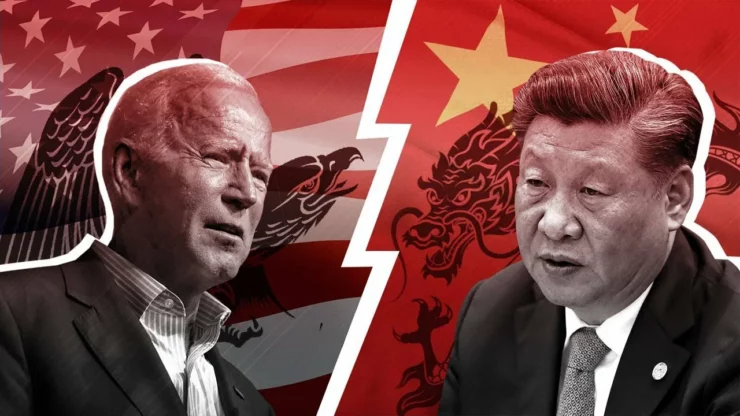
The defining geopolitical contest of the 21st century is no longer unfolding in silence. It is visible in trade policy, technology bans, military alliances, infrastructure financing, and even in the language of diplomacy itself.
From Washington to Beijing, two superpowers are shaping — and contesting — the architecture of global influence.
This is not a Cold War replay. It is something more complex: a rivalry rooted in economics as much as ideology, in supply chains as much as security, and in digital dominance as much as territorial control.
The central question is no longer whether competition exists. It is how far it will go — and how the rest of the world will navigate it.
The Economic Chessboard
At the heart of the rivalry lies economic power.
The United States remains the world’s largest economy in nominal terms, home to dominant financial institutions, a globally influential currency, and technological giants that shape digital ecosystems. The U.S. dollar continues to underpin global trade and central bank reserves.
Meanwhile, China has transformed itself into the world’s manufacturing powerhouse and the largest trading partner for dozens of nations. Its industrial scale, export capacity, and infrastructure outreach give it significant leverage across Asia, Africa, and Latin America.
Trade tensions between the two powers — including tariffs, export controls, and investment restrictions — signal that economics is no longer neutral ground. It is a strategic arena.
Semiconductors, rare earth minerals, artificial intelligence systems, and electric vehicle supply chains are now part of a broader contest for technological and industrial supremacy.
Technology: The New Frontline
If the 20th century was defined by military deterrence, the 21st century may be defined by digital dominance.
The United States leads in advanced chip design, software platforms, and high-end research ecosystems. China has invested heavily in domestic semiconductor manufacturing, artificial intelligence, 5G infrastructure, and quantum computing.
Export restrictions on advanced chipmaking equipment, along with limitations on technology transfer, highlight how sensitive innovation has become.
The result? A gradual decoupling in critical technology sectors.
Rather than a single interconnected digital world, we may see parallel ecosystems emerge — one centered around U.S.-aligned systems, and another built within China’s expanding technological sphere.
This divide is not just about devices and data. It is about setting global standards, shaping cybersecurity norms, and defining the rules of the digital economy.
Military Posturing and Strategic Geography
While economic rivalry dominates headlines, military positioning remains a powerful signal.
The United States maintains alliances and defense agreements across Europe and the Indo-Pacific, including partnerships through NATO and regional coalitions such as AUKUS.
China, for its part, has modernized its military capabilities at an accelerated pace, expanded its naval reach, and asserted territorial claims in the South China Sea.
The Taiwan Strait represents one of the most sensitive flashpoints. U.S. commitments to Taiwan’s defense capabilities intersect with Beijing’s insistence on sovereignty claims.
Both sides emphasize deterrence — but deterrence requires careful calibration. Missteps in strategic communication can escalate rapidly.
Infrastructure Diplomacy and the Global South
Influence is not won solely through military or technological dominance. It is also cultivated through development partnerships and economic outreach.
China’s Belt and Road Initiative has financed infrastructure projects across Asia, Africa, and parts of Europe, strengthening trade connectivity while expanding Beijing’s geopolitical footprint.
In response, Washington and its allies have launched alternative investment frameworks aimed at offering competing models of infrastructure financing, transparency, and governance standards.
For nations in the Global South, this rivalry presents both opportunity and complexity. Competition between superpowers can unlock funding and strategic partnerships — but it can also require delicate diplomatic balancing.
Currency, Trade, and Financial Leverage
Another dimension of influence lies in finance.
The dominance of the U.S. dollar allows Washington to enforce sanctions with global reach. Access to dollar-based financial systems is often essential for international trade.
China, however, is gradually promoting the internationalization of the renminbi and developing alternative payment systems to reduce reliance on dollar channels.
While the dollar remains preeminent, incremental shifts in trade settlement currencies and digital finance initiatives reflect a broader ambition to reshape monetary influence.
Financial power, like technological power, is part of the broader contest.
Alliances and Strategic Alignment
In this evolving landscape, alliances matter more than ever.
The United States emphasizes coalition-building, reinforcing relationships with European partners, Japan, South Korea, and Australia.
China prioritizes strategic partnerships, energy agreements, and multilateral engagement within forums such as BRICS and regional Asian institutions.
Many nations, particularly in Southeast Asia and the Gulf, are adopting pragmatic strategies — engaging economically with China while maintaining security ties with the United States.
The world is not dividing neatly into two blocs. Instead, it is navigating a more fluid, multi-aligned environment.
Competition Without Collapse?
The most pressing concern is whether this rivalry can remain competitive without becoming confrontational.
Economic interdependence between Washington and Beijing remains significant. Supply chains are deeply intertwined. Financial markets are connected. Consumer markets overlap.
Complete decoupling would be costly for both sides — and for the global economy.
Thus, the emerging model may resemble “managed rivalry”: intense competition within guardrails designed to prevent open conflict.
But maintaining those guardrails requires constant diplomatic engagement, crisis management channels, and recognition of mutual risk.
The View From the Middle
For regions like the Middle East, Southeast Asia, and Africa, the Washington–Beijing rivalry is not an abstract geopolitical contest — it shapes trade agreements, technology partnerships, defense cooperation, and infrastructure financing.
Countries are increasingly seeking strategic autonomy — diversifying partnerships rather than committing exclusively to one camp.
This balancing act reflects a broader global reality: the world is no longer unipolar, but neither is it rigidly bipolar.
A Contest That Defines the Century
The battle for global influence between Washington and Beijing is not defined by a single event. It is a sustained strategic competition spanning economics, technology, diplomacy, and security.
It is not simply about dominance — it is about shaping the rules of the international system.
Who sets technological standards?
Who controls critical supply chains?
Who defines trade norms?
Who builds infrastructure in emerging markets?
These questions will define global stability for decades to come.
What makes this rivalry particularly consequential is its scope. It touches nearly every country, industry, and institution.
The world is watching — not just to see who leads, but to determine how the competition unfolds.
Will it produce fragmentation or innovation? Division or disciplined diplomacy?
From Washington to Beijing, the contest for influence is reshaping the global order.
And its outcome will shape the century.
