
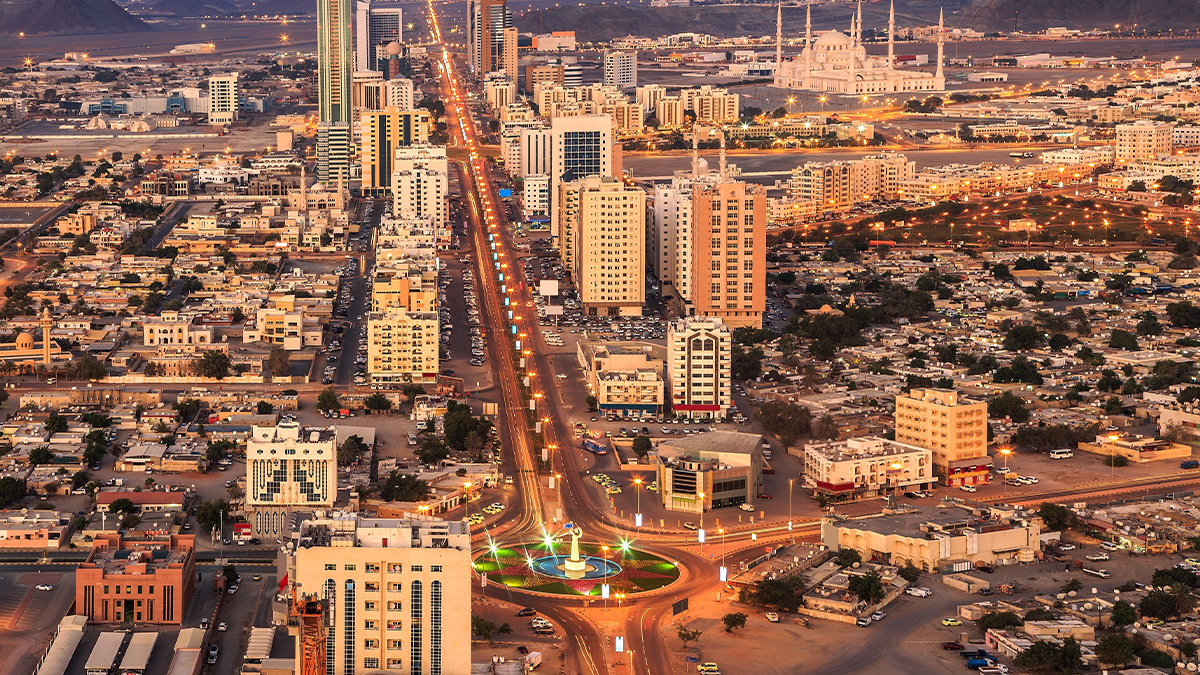
Fujairah is no longer just a scenic coastal emirate known for its mountains and beaches. In recent years, it has quietly transformed into one of the UAE’s most strategically positioned economic hubs. Investors are watching closely. Trade volumes are rising. Infrastructure projects are accelerating.
So what exactly is fueling Fujairah’s latest growth surge?
The answer lies at the intersection of geography, policy reform, infrastructure expansion, and a broader national strategy that continues to redefine the UAE’s economic landscape.
A Strategic Location That Commands Global Attention
Geography has always been Fujairah’s greatest advantage — but today, it is leveraging that advantage more effectively than ever before.
Unlike other emirates located along the Arabian Gulf, Fujairah sits on the eastern coastline, directly facing the Gulf of Oman. This positioning gives it critical access to international shipping lanes outside the Strait of Hormuz, making it a vital logistical gateway for global trade.
The operations of the Port of Fujairah have expanded steadily, strengthening the emirate’s role in fuel bunkering, container traffic, and maritime services. As global supply chains recalibrate following years of disruption, Fujairah’s logistical importance has only grown.
For businesses, this translates into one key word: reliability.
Infrastructure as the Engine of Growth
If geography is the advantage, infrastructure is the accelerator.
Massive investments in roads, port facilities, storage terminals, and industrial zones have enhanced Fujairah’s capacity to handle trade, energy storage, and manufacturing operations. The expansion of oil storage facilities in particular has positioned the emirate as one of the world’s largest bunkering hubs.
Energy trading activities continue to draw global players, while industrial areas near the port are seeing increased activity from logistics, shipping, and construction firms.
Infrastructure development doesn’t just improve logistics — it creates an ecosystem. Warehousing companies attract transport services. Transport services attract distribution centers. Distribution centers attract retail and manufacturing.
It’s a multiplier effect — and Fujairah is benefiting from it.
Economic Diversification in Action
The UAE’s long-term economic vision has focused heavily on diversification away from oil dependency. While major headlines often spotlight Abu Dhabi or Dubai, Fujairah has been steadily executing its own diversification strategy.
Tourism is expanding. Hospitality projects are growing. The emirate’s natural landscape — mountains, coastline, heritage sites — is drawing regional and international visitors alike.
Meanwhile, sectors such as fisheries, agriculture, logistics, construction, and small-scale manufacturing are gaining momentum. The focus is clear: build a resilient economy that balances industry, trade, and services.
This alignment with broader UAE policies has positioned Fujairah as a complementary growth engine rather than a competing one.
Business-Friendly Reforms and Investment Climate
Another crucial driver behind the growth surge is regulatory reform.
The UAE’s introduction of long-term residency options, business-friendly licensing structures, and foreign ownership reforms has strengthened investor confidence nationwide. Fujairah has benefited directly from these reforms.
Free zones and industrial areas offer competitive incentives for startups and established enterprises. Simplified licensing procedures and streamlined approvals make entry smoother for entrepreneurs.
Investors are not just looking for opportunity — they are looking for predictability. Fujairah’s regulatory environment is increasingly delivering that confidence.
Real Estate and Urban Expansion
Growth often leaves visible footprints — and in Fujairah, those footprints are becoming more prominent.
Residential developments, commercial projects, and mixed-use properties are gradually reshaping parts of the emirate. As business activity increases, demand for office spaces, retail outlets, and residential housing follows.
Unlike overheated markets elsewhere, Fujairah offers relative affordability — a factor that appeals to SMEs, startups, and investors seeking long-term value rather than speculative gains.
Urban expansion is measured, but deliberate. And that careful pace may be one of Fujairah’s strongest long-term advantages.
The Energy Factor: A Strategic Powerhouse
Energy remains central to Fujairah’s economic narrative.
The emirate plays a critical role in global oil storage and bunkering operations. Its storage capacity and pipeline connectivity have made it a key node in international energy logistics.
With evolving global energy dynamics, including shifts toward cleaner energy sources, Fujairah’s strategic infrastructure ensures it remains relevant — not just today, but in future energy transitions.
Energy security and trade resilience are global priorities. Fujairah is positioned at the heart of both.
SMEs and Entrepreneurship: The Quiet Contributors
Large infrastructure headlines often overshadow another essential driver: small and medium enterprises.
Local businesses — from logistics operators to service providers — form the backbone of economic activity. The rise in trade and industrial operations creates secondary demand across transport, maintenance, hospitality, and professional services.
Entrepreneurial momentum is building. As regulatory processes become more streamlined and economic visibility improves, Fujairah is gradually becoming more attractive to startups seeking lower operating costs compared to larger emirates.
In economic development, momentum matters. And Fujairah’s momentum is steadily compounding.
Regional Stability and Global Confidence
Economic growth does not occur in isolation. It requires political stability, investor trust, and international confidence.
The UAE’s broader reputation as a safe and stable business environment continues to benefit all emirates. Fujairah’s expansion is supported by this national framework of governance, infrastructure reliability, and global trade partnerships.
In a world facing geopolitical shifts and supply chain recalibration, stability is a premium asset.
Challenges on the Horizon
No growth story is without challenges.
Global energy price volatility, shifts in trade dynamics, and competitive pressures from neighboring ports require strategic adaptability. Additionally, sustainable development and environmental considerations are becoming increasingly important for long-term planning.
However, Fujairah’s development model — steady, infrastructure-driven, and strategically aligned with national goals — suggests resilience rather than vulnerability.
The Bigger Picture
Perhaps the most intriguing aspect of Fujairah’s economic surge is not just the numbers — it’s the trajectory.
The emirate is not experiencing a sudden boom driven by speculation. Instead, it is building structural capacity: ports, pipelines, industrial zones, regulatory reform, and tourism development.
This is foundational growth.
And foundational growth tends to last.
As global trade patterns evolve and the UAE continues its diversification journey, Fujairah’s role appears set to expand further. Investors, businesses, and policymakers are increasingly recognizing that the emirate is no longer peripheral to the national economy — it is becoming central to its future.
The question is no longer whether Fujairah is growing.
The real question is: how far can this momentum go?
If current indicators are any measure, Fujairah’s economic expansion may only be entering its next chapter.
