
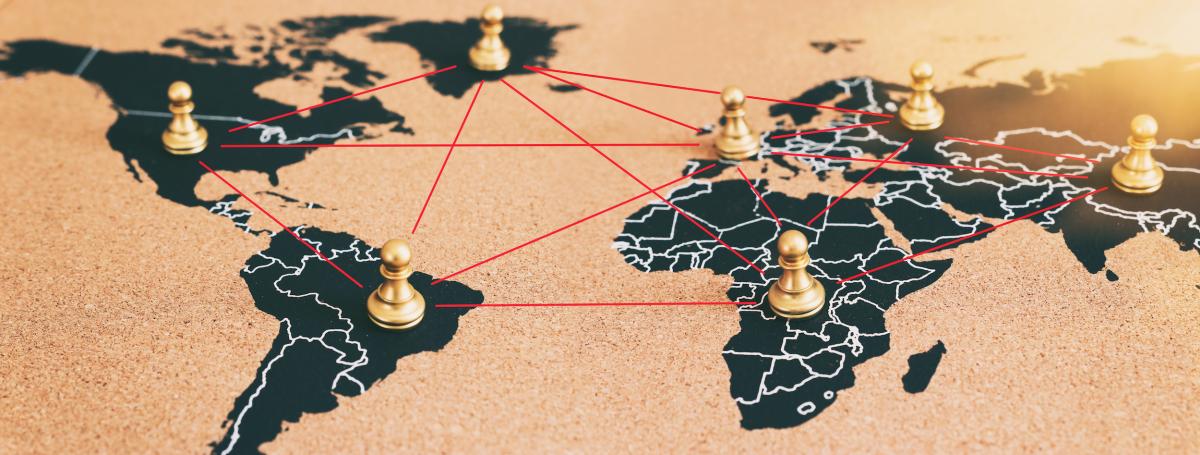
Global trade has always been shaped by politics. But in today’s climate, geopolitics is no longer operating in the background — it is steering the ship.
From sanctions and tariff wars to shifting alliances and strategic chokepoints, the architecture of global commerce is being rewritten in real time. Supply chains once optimized purely for efficiency are now being redesigned for resilience. Trade routes once considered permanent are being reconsidered. And investors, policymakers, and corporations are all asking the same question:
What comes next?
A World Moving Away from Certainty
For decades, globalization operated on a relatively predictable formula: open markets, expanding trade agreements, and integrated supply chains stretching across continents. Goods moved where labor was cheapest. Capital flowed where returns were highest. Efficiency was king.
Today, that formula is under pressure.
Rising tensions between major global powers, particularly the United States and China, have introduced a new era of strategic competition. Trade policies are increasingly intertwined with national security considerations. Tariffs are no longer just economic tools; they are political statements.
In this environment, global trade is no longer simply about comparative advantage — it is about strategic alignment.
The Weaponization of Trade
Sanctions, export controls, and technology restrictions have become defining features of modern geopolitics. Nations are leveraging their economic influence as instruments of pressure.
This “weaponization of trade” has led to a fragmentation of global commerce. Critical industries — semiconductors, rare earth minerals, energy infrastructure — are now viewed through the lens of sovereignty and security.
The consequences are significant:
- Companies are rethinking cross-border dependencies.
- Governments are incentivizing domestic production.
- Multinational corporations are diversifying supply bases.
The age of hyper-globalization appears to be giving way to what analysts describe as “selective globalization” — trade that continues, but with strategic filters applied.
Supply Chains: From Efficiency to Resilience
Perhaps nowhere is the impact of geopolitical tension more visible than in supply chains.
For years, corporations pursued lean, cost-optimized models. Production was centralized. Inventory was minimized. Logistics were streamlined.
But disruptions — from pandemics to regional conflicts — exposed vulnerabilities. Ports clogged. Factories halted. Shipping costs soared.
Now, resilience is the new priority.
Companies are adopting strategies such as:
- Nearshoring: Moving production closer to consumer markets.
- Friend-shoring: Partnering with politically aligned nations.
- Multi-sourcing: Avoiding reliance on a single supplier or country.
These shifts may increase short-term costs, but they reduce exposure to geopolitical shocks.
Trade, in essence, is becoming more cautious.
Energy Politics and Strategic Routes
Energy remains a central pillar of global trade — and geopolitical tensions are reshaping this sector dramatically.
Conflicts and sanctions have redirected oil and gas flows across continents. New pipeline agreements are emerging. Liquefied natural gas (LNG) shipments are finding alternative buyers. Strategic reserves are being recalibrated.
Shipping routes are also under scrutiny. Chokepoints such as the Strait of Hormuz, the Suez Canal, and the South China Sea carry not only cargo but geopolitical risk. Any instability along these routes sends ripples across global markets.
In response, countries are investing in diversified energy corridors and maritime alternatives. Strategic geography is regaining prominence as a decisive economic factor.
The Rise of Regional Trade Blocs
While global integration faces headwinds, regional integration is gaining momentum.
Trade agreements within Asia, Europe, the Gulf Cooperation Council (GCC), and other blocs are strengthening intra-regional commerce. Nations are seeking stability through partnerships with neighbors and trusted allies.
This shift suggests that globalization is not ending — it is being reorganized.
Instead of one interconnected global web, we may see a constellation of regional hubs — interconnected but semi-autonomous.
For investors, this means identifying which regions are becoming anchors of stability and growth.
Technology and the New Trade Divide
Technology is perhaps the most sensitive front in geopolitical trade tensions.
Advanced semiconductors, artificial intelligence systems, cybersecurity infrastructure, and telecommunications networks are no longer just commercial products — they are strategic assets.
Export restrictions on high-tech components are accelerating the fragmentation of global tech ecosystems. Countries are investing heavily in domestic semiconductor production. Technology partnerships are being scrutinized for national security risks.
The result is a digital divide that may mirror geopolitical divides — creating parallel systems rather than unified platforms.
Inflation, Protectionism, and Consumer Impact
Geopolitical tensions inevitably influence prices.
Tariffs, supply disruptions, and strategic stockpiling can increase production costs, which are often passed on to consumers. Protectionist policies, while politically appealing, may contribute to inflationary pressures.
For emerging markets, the stakes are even higher. Dependence on imported energy or commodities makes them particularly vulnerable to trade disruptions.
Thus, geopolitical trade tensions are not abstract diplomatic maneuvers — they affect everyday goods, fuel prices, and economic stability worldwide.
What Comes Next?
The future of global trade will likely be defined by a delicate balancing act.
1. Resilient Globalization
Trade will continue, but with built-in safeguards. Redundancy will replace singular dependency.
2. Strategic Alliances
Political alignment will influence trade flows more than ever before.
3. Technological Sovereignty
Countries will push for self-reliance in critical sectors, particularly in digital and energy technologies.
4. Regional Economic Strengthening
Regional trade agreements may deepen, creating clusters of stability.
5. Increased Corporate Adaptability
Companies will need to become geopolitical analysts as much as business strategists.
A World in Transition
Geopolitical tensions are not new. History has repeatedly shown that trade adapts to political realities. What makes this moment unique is the scale and speed of transformation.
Global trade is no longer governed solely by market logic. It is increasingly influenced by strategic caution, political leverage, and long-term security considerations.
The question is not whether globalization will survive — it likely will, in altered form.
The real question is: who will adapt fastest?
Nations that build diversified trade partnerships, secure supply chains, and technological independence will be better positioned for the next chapter. Businesses that anticipate disruption rather than react to it will gain competitive advantage.
In a world where geopolitics and commerce are inseparable, understanding the intersection between the two is no longer optional.
It is essential.
And as this new era unfolds, one thing is certain: global trade is not retreating — it is recalibrating.
