
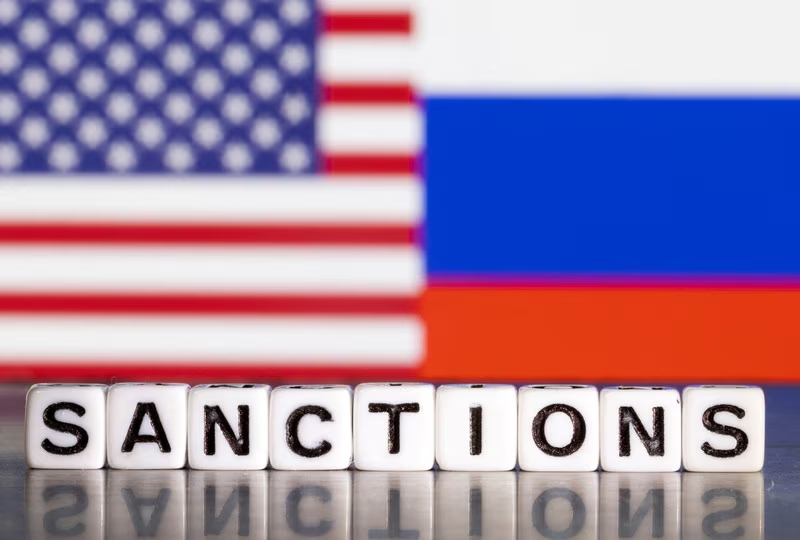
War no longer begins with tanks crossing borders.
It begins with banking restrictions, export controls, frozen assets, and severed supply chains.
In the 21st century, economic power has become a weapon — precise, scalable, and globally consequential. Sanctions are no longer peripheral tools of diplomacy. They are central instruments of geopolitical strategy.
From great-power rivalries to regional conflicts, the world is witnessing the rise of a new form of confrontation: economic warfare.
The Weaponization of Finance
At the heart of modern sanctions lies financial dominance.
The global reach of the U.S. dollar gives the United States unparalleled leverage. Because so much of global trade is settled in dollars and cleared through American-linked financial systems, Washington can restrict access to the arteries of global commerce.
When Russian forces entered Ukraine in 2022, sweeping sanctions followed. Major Russian banks were cut off from international financial networks, foreign reserves were frozen, and export controls targeted key technologies. The response was coordinated across the European Union, the United Kingdom, Japan, and others — a demonstration of how financial alliances can act collectively.
Sanctions in this case were not symbolic. They aimed to degrade economic capacity, limit technological access, and constrain long-term strategic capabilities.
This marked a shift. Economic tools were not just signals of disapproval — they were instruments of sustained pressure.
Strategic Isolation and Economic Containment
Sanctions are rarely about immediate collapse. More often, they aim at attrition.
Iran offers another example. Years of restrictions on oil exports, banking access, and foreign investment have shaped Tehran’s economic trajectory. Despite this pressure, Iran has adapted — cultivating alternative trade channels and regional partnerships.
Meanwhile, trade tensions between the United States and China reflect a different form of economic warfare — one focused less on isolation and more on strategic containment.
Export controls on advanced semiconductors and chipmaking equipment signal that technology access has become a security issue. The goal is not necessarily to halt economic exchange entirely, but to limit advancements in sectors deemed strategically sensitive.
Economic confrontation is increasingly targeted, sector-specific, and forward-looking.
The Global Financial Infrastructure
The architecture enabling economic warfare rests on global institutions and networks.
Systems such as SWIFT facilitate cross-border transactions. Exclusion from these systems can cripple trade flows and banking operations.
Sanctions also rely on regulatory enforcement, compliance mechanisms, and international cooperation. The more aligned major economies are, the more effective sanctions become.
Yet this same infrastructure also motivates targeted countries to develop alternatives — parallel payment systems, bilateral currency swaps, and digital financial networks designed to bypass traditional Western-dominated channels.
In attempting to enforce compliance, sanctioning powers may inadvertently accelerate financial fragmentation.
Adaptation and Survival
No sanctioned nation remains static.
Russia redirected energy exports toward Asia. Iran strengthened regional trade ties. Venezuela sought alternative financial routes. China has promoted the gradual internationalization of its currency and cross-border payment mechanisms.
Sanctions often trigger innovation under pressure. Domestic industries may receive state support. Informal trade networks expand. Currency controls tighten.
But adaptation comes at a cost: inflation, currency volatility, limited foreign investment, and technological stagnation.
For civilian populations, economic warfare can translate into rising prices, reduced access to imported goods, and constrained employment opportunities.
The line between strategic pressure and humanitarian impact is thin — and politically sensitive.
Secondary Sanctions and Global Compliance
One of the most powerful tools in modern economic warfare is the secondary sanction.
Rather than targeting only the primary state, sanctioning governments penalize third parties — companies or countries — that continue business with the sanctioned entity.
This expands the pressure outward, compelling multinational corporations and financial institutions to comply, even if their own governments are not directly involved.
The result is a powerful web of economic influence. Few global firms can afford exclusion from Western markets or financial systems.
Yet this extraterritorial reach also fuels criticism. Some nations view it as an overextension of power — a sign that global economic governance is increasingly politicized.
The Risk of Economic Fragmentation
As sanctions become more frequent and more sophisticated, a critical question emerges: Does economic warfare undermine globalization itself?
Trade interdependence once functioned as a stabilizer — a deterrent against conflict. But if interdependence becomes a vulnerability, states may prioritize resilience over efficiency.
Supply chains are being diversified. Strategic industries are being reshored. Governments speak of “economic security” alongside national security.
The global economy may be entering an era of guarded connectivity — still interconnected, but increasingly cautious.
Effectiveness and Limits
Do sanctions work?
The answer depends on the objective.
If the goal is immediate political capitulation, history suggests limited success. Sanctions rarely force rapid regime change.
If the aim is long-term constraint — limiting military modernization, reducing fiscal flexibility, and increasing diplomatic leverage — sanctions can exert meaningful pressure.
However, overuse risks diminishing impact. If too many states develop alternative systems, the centrality of traditional financial hubs could erode over time.
Economic warfare is powerful — but not without trade-offs.
Strategy in a Sanctioned World
Governments today are designing economic policies with sanctions in mind.
Resilience planning includes stockpiling critical resources, diversifying trade partners, developing domestic manufacturing capacity, and investing in alternative financial systems.
The language of statecraft now includes phrases like “de-risking,” “supply chain sovereignty,” and “strategic autonomy.”
The battlefield has shifted — from physical terrain to financial networks, from troop deployments to trade restrictions.
The Human Dimension
Behind macroeconomic indicators lie human consequences.
Sanctions can pressure elites and industries, but they also affect households and small businesses. Currency depreciation reduces purchasing power. Limited imports constrain consumer choice. Access to medicine and essential goods can become complicated, even when exemptions exist.
Balancing strategic goals with humanitarian considerations remains one of the greatest ethical challenges of economic warfare.
A New Era of Power Projection
Sanctions, once seen as alternatives to war, are now integral to geopolitical competition.
They allow states to project power without direct military engagement. They signal resolve. They impose costs. They shape incentives.
But they also redefine globalization — transforming economic integration from a shared platform into a contested arena.
The future of economic warfare will likely involve greater precision: targeted financial measures, technology restrictions, digital currency controls, and coordinated multilateral action.
As sanctions, strategy, and survival become intertwined, one truth stands out:
Power in the modern world is not measured only in armies or territory.
It is measured in access — to markets, to technology, to capital, and to networks.
And in the age of economic warfare, control over access may prove to be the most decisive weapon of all.
